Parenting tools for neurodivergent kids — calm the meltdowns, build the skills.
Calm, Confident, Connected is the app that teaches you why your child's brain works differently — and gives you word-for-word scripts, behavior tracking, and printable tools to help.
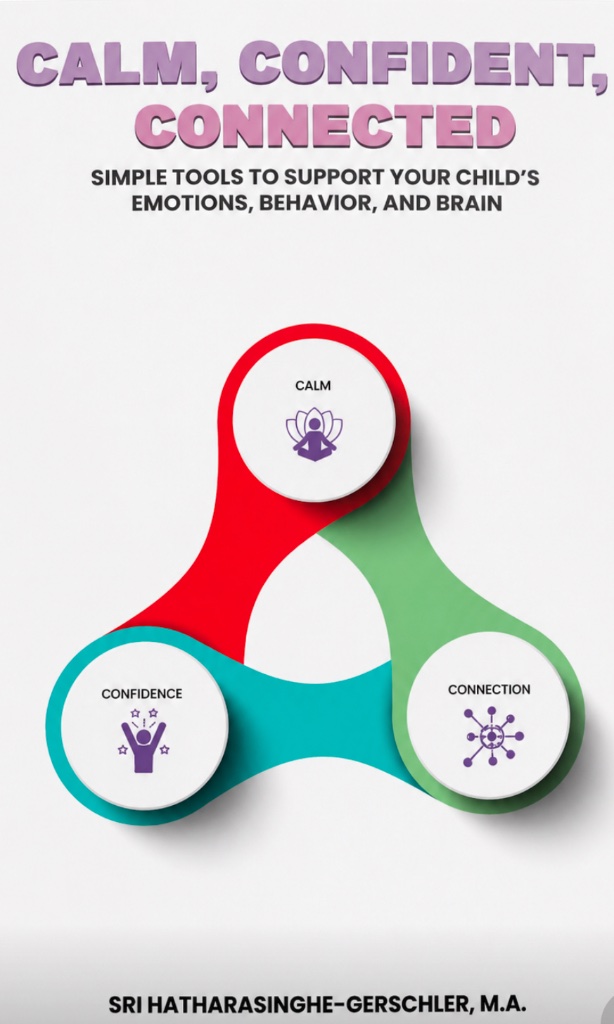
"Simple Tools to Support Your Child's Emotions, Behavior, and Brain"
Sri Hatharasinghe-Gerschler, M.A.
The Three Pillars of Our Framework
CALM
Teaching children and parents practical tools to find calm in the storm — breathing, body awareness, and sensory regulation.
CONFIDENCE
Building self-trust and resilience through consistent wins, skill-building, and knowing what to do when things get hard.
CONNECTION
Strengthening the parent-child bond so your child feels safe enough to co-regulate and grow through challenges.
Why Kids Struggle — And What Actually Helps
Most parenting advice tells you what to do. This platform helps you understand why — so the strategies you use actually work.
Zones of Regulation
The most widely used emotional regulation framework — broken down for parents in plain language, with scripts for each zone.
All Behavior Is Communication
Your child's meltdowns, refusals, and rigidity all have a reason: connection, access, escape, or sensory. Learn to read it.
Energy Management & ADHD
Spoon Theory explains why neurodivergent kids run out of steam faster — and how to plan your day to prevent dysregulation.
Dopamine & The ADHD Brain
Understanding brain chemistry takes the blame out of the picture — and gives you strategies that work with your child's brain, not against it.
8 Classes. 8 Certificates.
Each class is self-paced and standalone. Complete it, earn your certificate, and carry the knowledge into your daily life.
Module 01
Zones of Regulation
- Blue, Green, Yellow & Red zones
- What each zone feels like in the body
- Parent support tools per zone
- Kid-friendly scripts for hard moments
Module 02
Self-Regulation & Delayed Gratification
- What self-regulation really means
- The science of delayed gratification
- Working memory strategies
- Real-life teaching examples
Module 03
Why Behaviors Happen
- All behavior is communication
- Connection, Access, Escape & Sensory needs
- The parent-friendly reframe
- 4-step support script for hard moments
Module 04
Practice & Prevention
- Why practice when calm works
- The 4 Pillars of Prevention
- Building a daily 5-minute practice routine
- Making coping skills automatic
Module 05
Energy Management (Spoon Theory)
- Understanding finite energy with ADHD/neurodivergence
- What drains spoons faster
- Smart energy management strategies
- Building self-compassion into daily life
Module 06
Routines & Predictability
- Why routines regulate the nervous system
- Building effective visual routines
- Troubleshooting common routine problems
- The connection to meltdown prevention
Module 07
Teaching Flexibility
- Understanding rigidity in kids
- Plan A / Plan B language
- Flexibility games & daily practice
- Building adaptability over time
Module 08
Dopamine & Brain Chemistry
- How dopamine drives behavior
- The ADHD dopamine connection
- Why kids resist low-dopamine tasks
- Strategies to support healthy regulation
Your Certificates Celebrate Your Growth
Completion certificates document your commitment to your children's wellbeing and recognise the real work you are putting in as a parent.
A Complete System for the Whole Family
Beyond the parent modules, the platform includes interactive tools for every member of the family.
8 Parent Certification Modules
Zones of Regulation, behavior communication, self-regulation, routines, flexibility, energy management, and brain chemistry — all in one place.
Executive Functioning Coach
AI-powered coaching to build planning, impulse control, and emotional regulation skills — personalised to your child.
Behavior Tracking & Logs
Track triggers, behaviors, and what worked — so you can spot patterns and prevent the hard moments before they start.
Scripts for Tough Moments
Word-for-word parent scripts for transitions, refusals, aggression, meltdowns, and bedtime battles — so you never have to figure it out in the moment.
For Kids (3–12)
- Zones of Regulation games
- Calm corner activities
- Visual schedules
- Interactive coping tools
For Teens (13–18)
- Friendship & social skills
- Self-regulation tools
- Private teen check-ins
- Transition planning support
Printable Toolkits
- Behavior tracking sheets
- Calm-down cards
- Visual routine boards
- First-then boards
Supporting Autistic Children & Their Families
Our evidence-based framework is widely used by parents and therapists to support autistic children — helping them navigate emotions, transitions, and sensory overwhelm.
Visual Schedules & Predictability
Autistic children thrive with structure. Our visual routine tools reduce anxiety by making the day predictable and clear.
Zones of Regulation
A widely-used framework in autism therapy — helping children identify their emotional state and choose appropriate coping strategies.
Sensory & Energy Management
Spoon Theory helps explain why autistic children become dysregulated — and teaches families how to prevent meltdowns before they start.
Behavior as Communication
Meltdowns, shutdowns, and rigidity all have a reason. Our modules teach parents to understand and respond with empathy and strategy.
Flexibility & Transitions
Rigid thinking and difficulty with change are common in autism. Our flexibility tools and games build adaptability gradually.
Social Skills for Teens
Dedicated teen friendship training and social skills tools designed to build connection and confidence in social situations.
Practical Strategies for Autism & Down Syndrome
Real, day-to-day tips from our evidence-based framework — for parents navigating life with neurodiverse children.
Autism Parenting Tips
Give Transition Warnings
Say "5 more minutes, then we leave" twice before every transition. Predictability reduces meltdowns dramatically for autistic children.
Use Fewer Words
During dysregulation, keep language simple. One instruction at a time. Short, calm sentences. Less language = less overwhelm.
Validate Sensory Needs
Headphones in noisy places, sunglasses indoors, seamless socks — accommodating sensory needs is not "giving in." It's removing a barrier.
Teach Flexibility in Calm Moments
Practice small changes when everyone is regulated — a different route home, a new food touching the plate. Build the muscle slowly.
Use Visual Supports
Picture schedules, first-then boards, and written rules work better than verbal reminders alone. Visual information stays visible longer than spoken words.
Celebrate Effort, Not Outcome
Praise the attempt: "I saw you try to wait" or "You used your words when you were upset." This builds intrinsic motivation over time.
Down Syndrome Parenting Tips
Go at Their Pace
Children with Down syndrome may reach milestones later — that's completely normal. Celebrate each step instead of comparing to timelines.
Repeat, Repeat, Repeat
Short, consistent practice every day beats long sessions weekly. Repetition is how skills get consolidated — be patient and keep it fun.
Lean Into Strengths
Many children with Down syndrome are strong visual learners with great social warmth. Use pictures, demonstrations, and social connection as learning tools.
Keep Routines Predictable
Consistent daily routines reduce anxiety and support memory development. Use visual schedules to make the day feel safe and clear.
Support Communication Every Way
Sign language, picture cards, AAC devices, and speech together are not "instead of talking" — they all build communication and reduce frustration.
Use Play as the Teacher
Learning happens best through play for children with Down syndrome. Games, songs, and pretend play are not "just fun" — they are therapy in disguise.
Oppositional Defiant Disorder (ODD) Tips
Offer Choices, Not Commands
Instead of "Put your shoes on NOW," try "Do you want to put on your shoes first or grab your backpack first?" Choice reduces the power struggle.
Stay Regulated Yourself First
Children with ODD escalate when adults escalate. Your calm is the most powerful tool you have. Regulate yourself before trying to co-regulate them.
Pick Your Battles Intentionally
Not every hill is worth fighting on. Decide in advance which 2–3 behaviors are non-negotiable and let the smaller stuff go for now.
Avoid Direct Commands When Possible
Frame requests as observations or questions: "The dog looks hungry" instead of "Feed the dog." Less direct = less resistance.
Catch Them Being Compliant
Notice and name every moment of cooperation — even small ones. "You did that first time I asked — I noticed that." ODD kids rarely hear what they do right.
Use Delayed Consequences
"We'll talk about this when we're both calm" removes the in-the-moment power struggle. Come back to it 20 minutes later — calmly and briefly.
Get the Free Emotional Regulation Checklist
Know exactly which zone your child is in — and what to do — in under 5 minutes.
Simple to Start, Powerful Over Time
Create Your Family Profile
Set up profiles for each of your children. The platform adapts to each child's age and needs.
Complete the Modules
Work through the 8 parent classes at your own pace and earn a completion certificate for each one.
Use the Daily Tools
Zone check-ins, behavior logs, visual schedules, calm corners — everything you need to reinforce learning in real life.
Real Families, Real Results
"My son went from daily meltdowns to maybe one a week. Understanding the Zones of Regulation changed everything for our whole family."
Sarah M.
Parent of a child with ADHD, age 8
"Finally understanding WHY my daughter melts down — connection, escape, sensory — has made me so much more patient and effective as a parent."
Michael R.
Parent of an autistic child, age 10
"The Spoon Theory module was a revelation. I stopped expecting my ADHD kid to 'just try harder' and started planning around his energy instead."
Priya K.
Mother of 2, ages 7 & 13
Frequently Asked Questions
Everything parents ask before they get started.
Is this right for my child's diagnosis?
Yes. The framework is designed for parents of children with ADHD, autism, sensory processing differences, anxiety, and Down syndrome — ages 0 to 18. The tools adapt to your child's age, needs, and developmental stage.
How is this different from parenting books or Instagram advice?
Books and social media give you tips. This platform gives you a structured curriculum of 8 self-paced certification modules PLUS daily tools you actually use in the moment — behavior tracking, visual schedules, calm-down corners, and word-for-word parent scripts for tough situations.
Is my child's data safe?
Your child's data stays private. We don't sell it, we don't share it, and you can delete it anytime. Behavior logs are stored securely and encrypted in transit.
What are Sri's qualifications?
Sri Hatharasinghe-Gerschler holds an M.A. and is the author of "Calm, Confident, Connected: Simple Tools to Support Your Child's Emotions, Behavior, and Brain." The platform is built directly from her evidence-based framework.
How much does it cost?
$9.99 per month. That includes all 8 certification modules, the AI executive-functioning coach, behavior tracking, kids and teens tools, and every printable toolkit. Cancel anytime.
Can I cancel anytime?
Yes — cancel anytime with one click, no questions asked. We also offer a 30-day money-back guarantee if you're not satisfied.